
When I was a kid, I imagined Brussels sprouts as little cabbages with their heads growing out of the ground, carefully picked in Belgium by … children, maybe? … and sent to us in the States.
That is not how they grow. They grow like this:
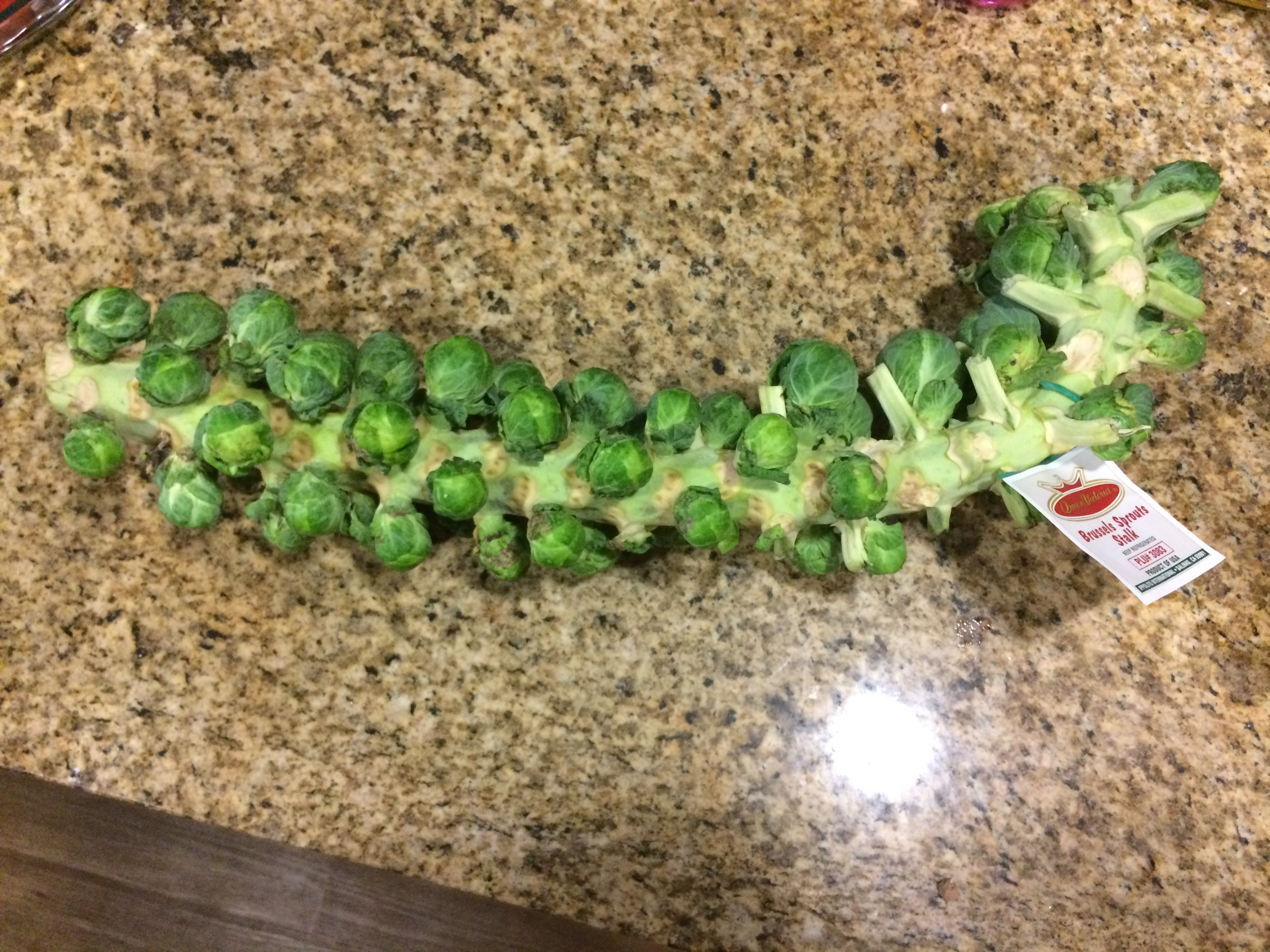
It’s quick and easy to work down the stalk, twisting and snapping off the little sprouts. So easy, in fact, that it’s baffling you usually pay much less per sprout when you buy a whole stalk.
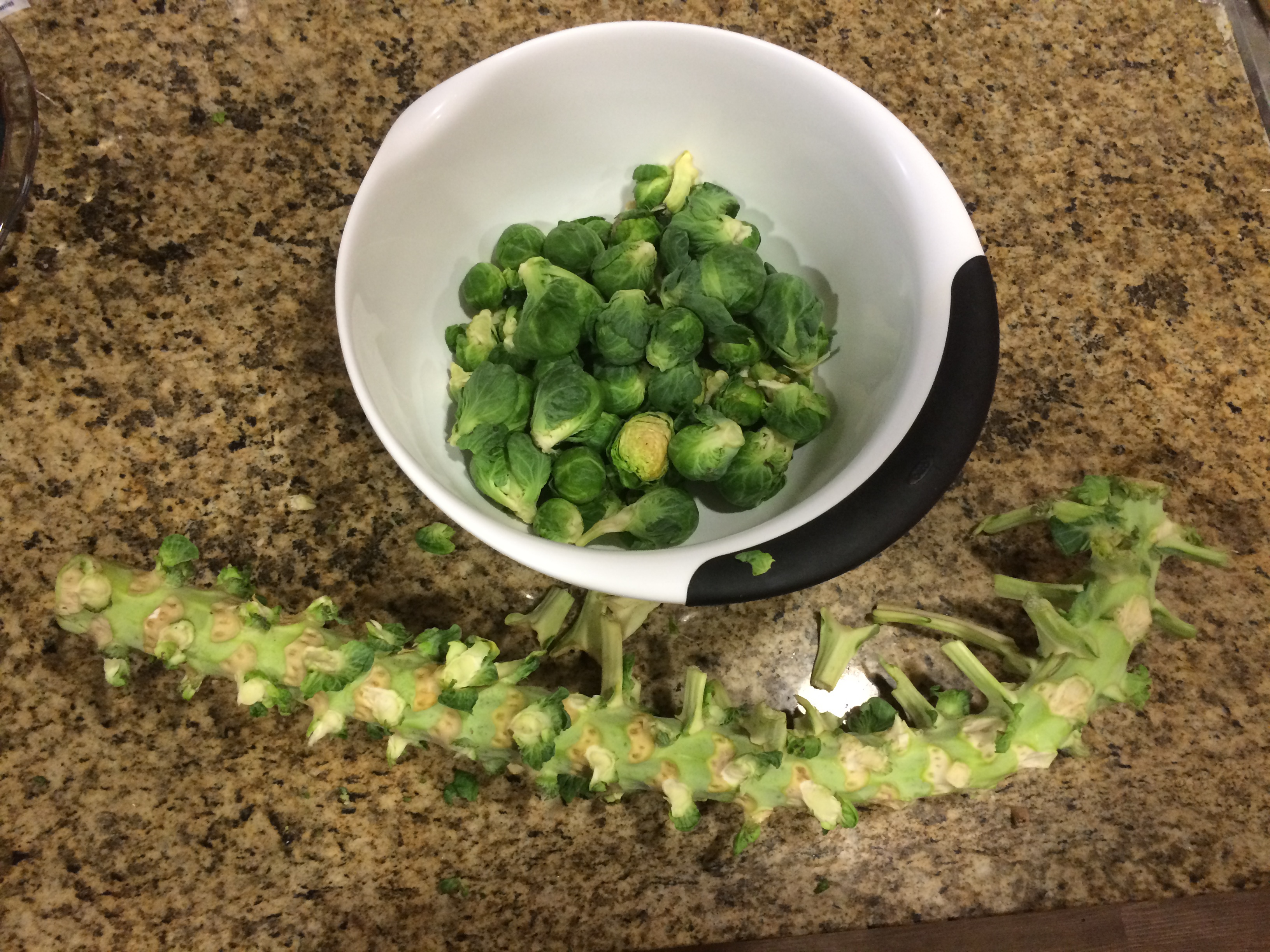
But that stalk! Aye, that stalk! It’s heavy. It’s like a baseball bat. And I feel wasteful every time I compost one—or, with no compost bin these days, throw one in the trash.
Can a Brussels sprout stalk be eaten? Is it edible?
I turned to the internet. Someone had asked the same question years earlier, so I wasn’t exactly the first person to ponder this. The answers ranged from “yes” to “no” to “technically, but why would you do that to yourself?” Several people said the shoots were edible and tasty. Others warned that the stalk required heroic peeling, and that there are Brussels sprout cultivars explicitly grown to make walking sticks.
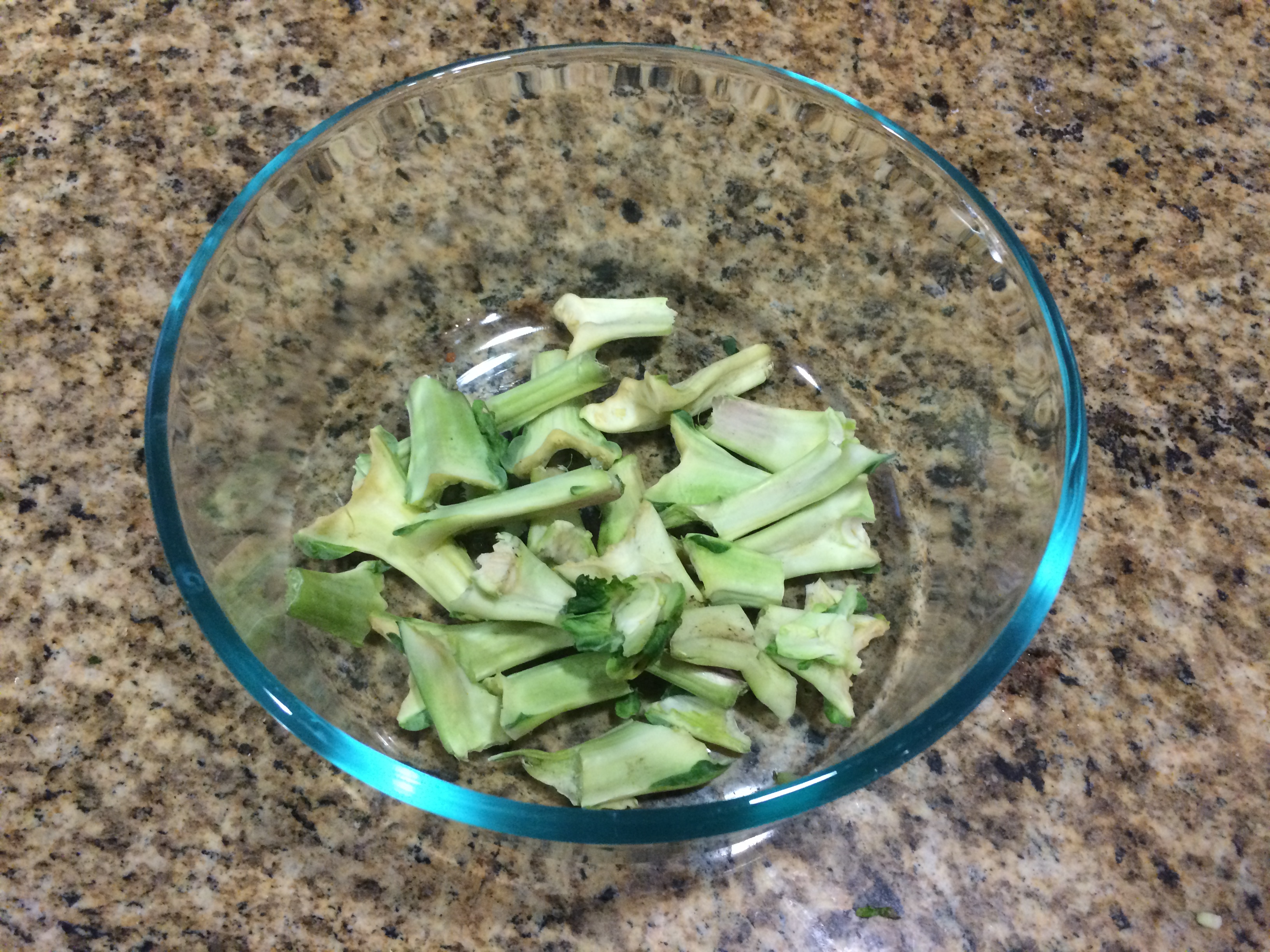
Then I found a promising claim: cut the stalk into six-inch segments and steam them until they crack open.
Aha. A lead.
But about that verb cut: yikes. I don’t own a cleaver. I’m never going to own a cleaver. I’m terrified of cleavers. My stalk seemed fresh, though, and I thought leaning on the blade of a sharp, heavy knife might work. So I started up the stalk in six-inch increments, wondering whether this Brussels walking stick was ruining my $54 J.A. Henckels santoku.
It turns out you don’t have to cut all the way through. Score the stalk about ¼ inch deep all the way around, then snap it at the cut. Less hacking. Less knife-dulling. More dignity all around.
Awesome. Now I could see what was inside.
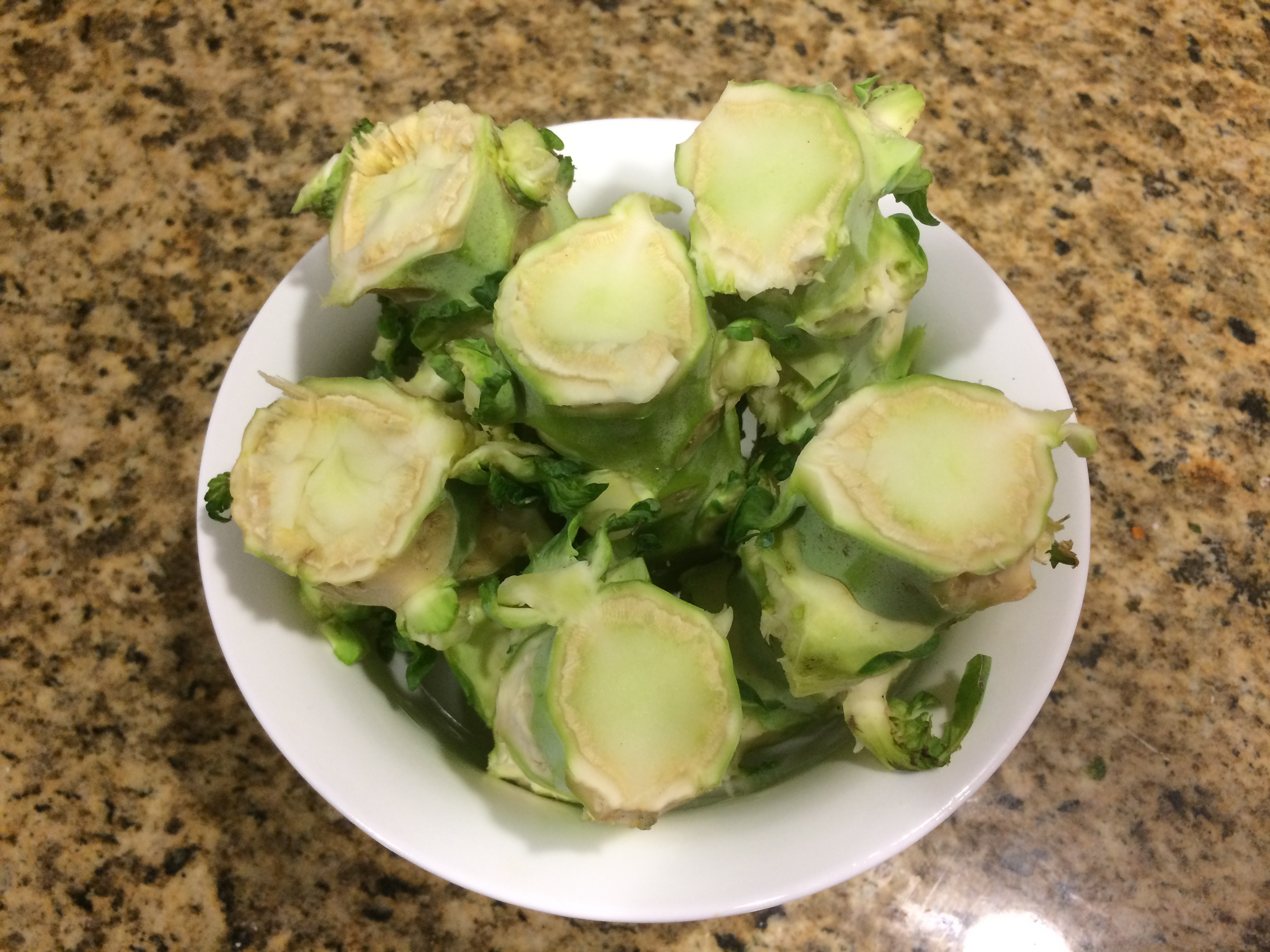
Steam until “done,” huh? You could hammer nails with the core of that stalk. I could imagine someone reaching this point, abandoning the food experiment, and going the walking stick route with it.
But into the steamer basket the pieces went. I wondered how long “done” would take.
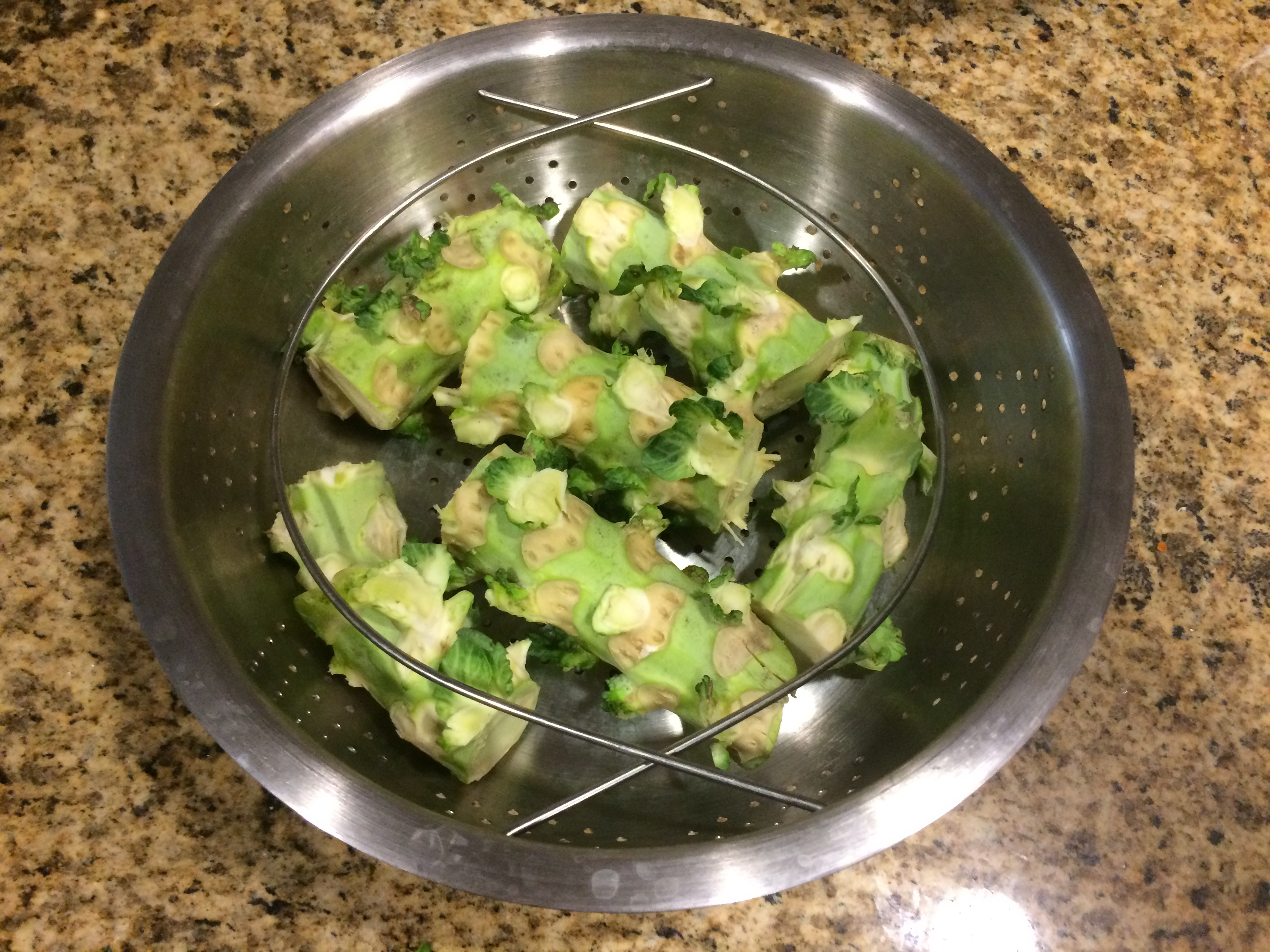
I checked every five minutes. After fifteen minutes, there was not much progress.
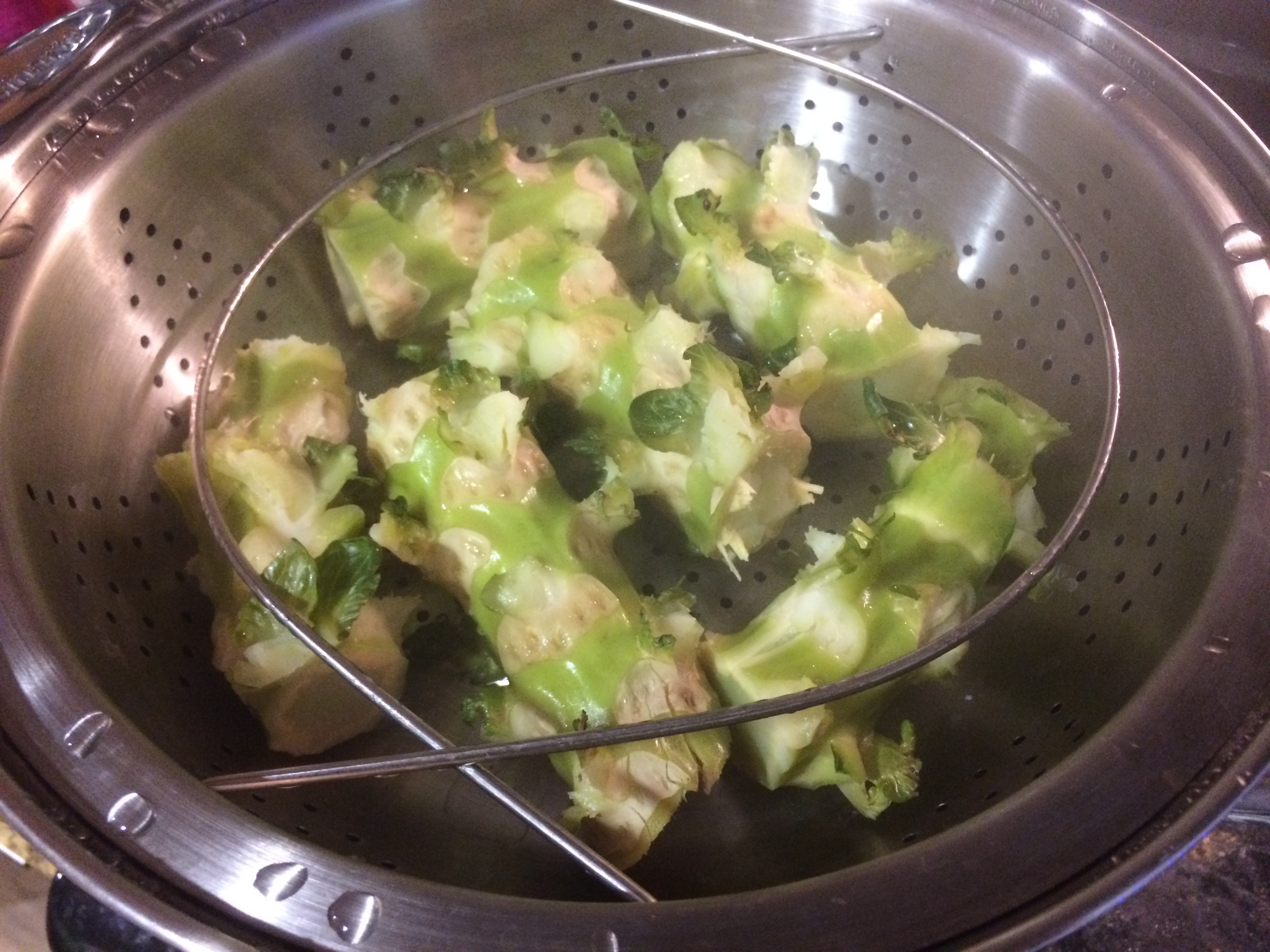
Same story at half an hour.
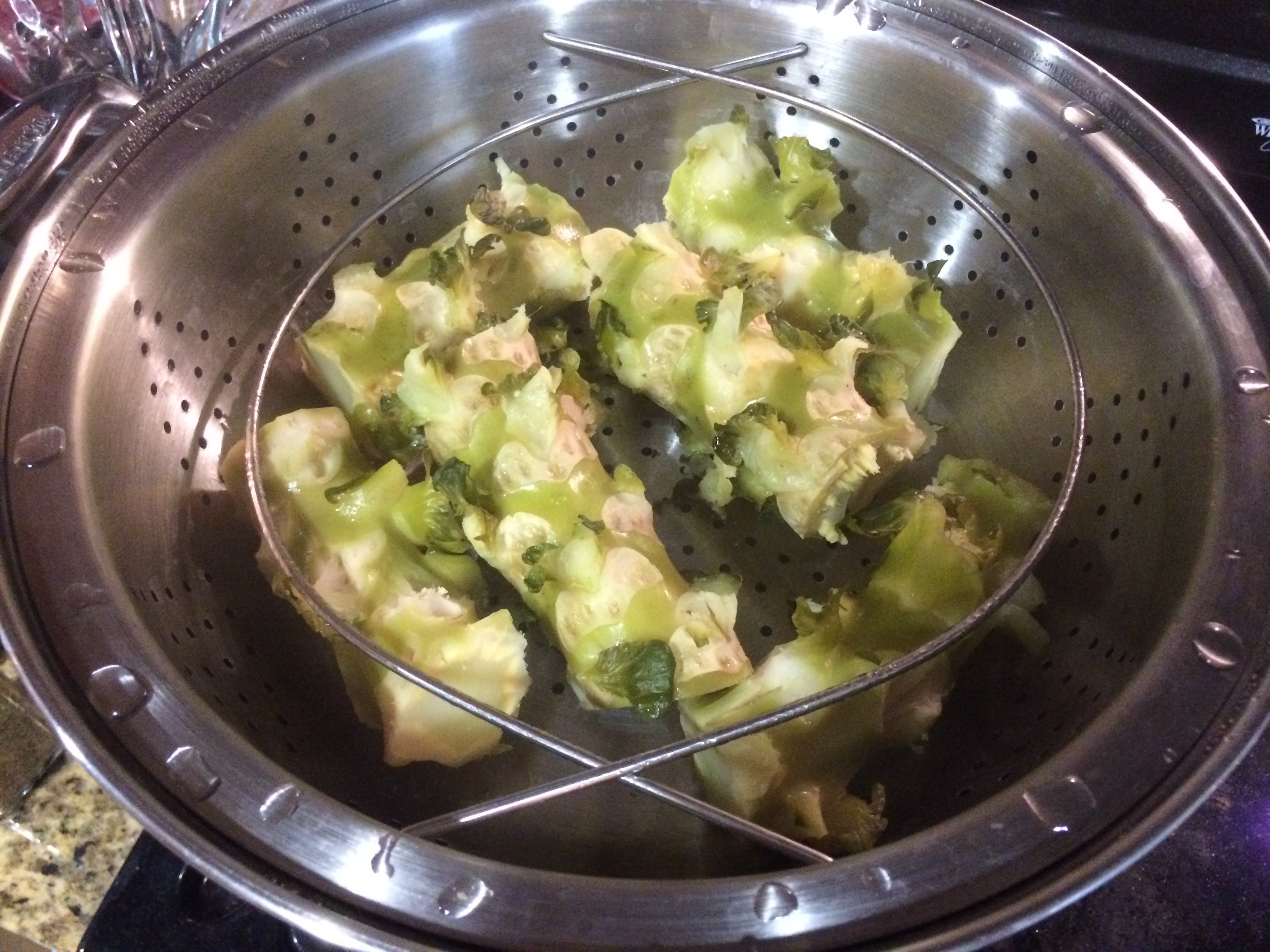
At an hour: aha! Cracks in two of them!
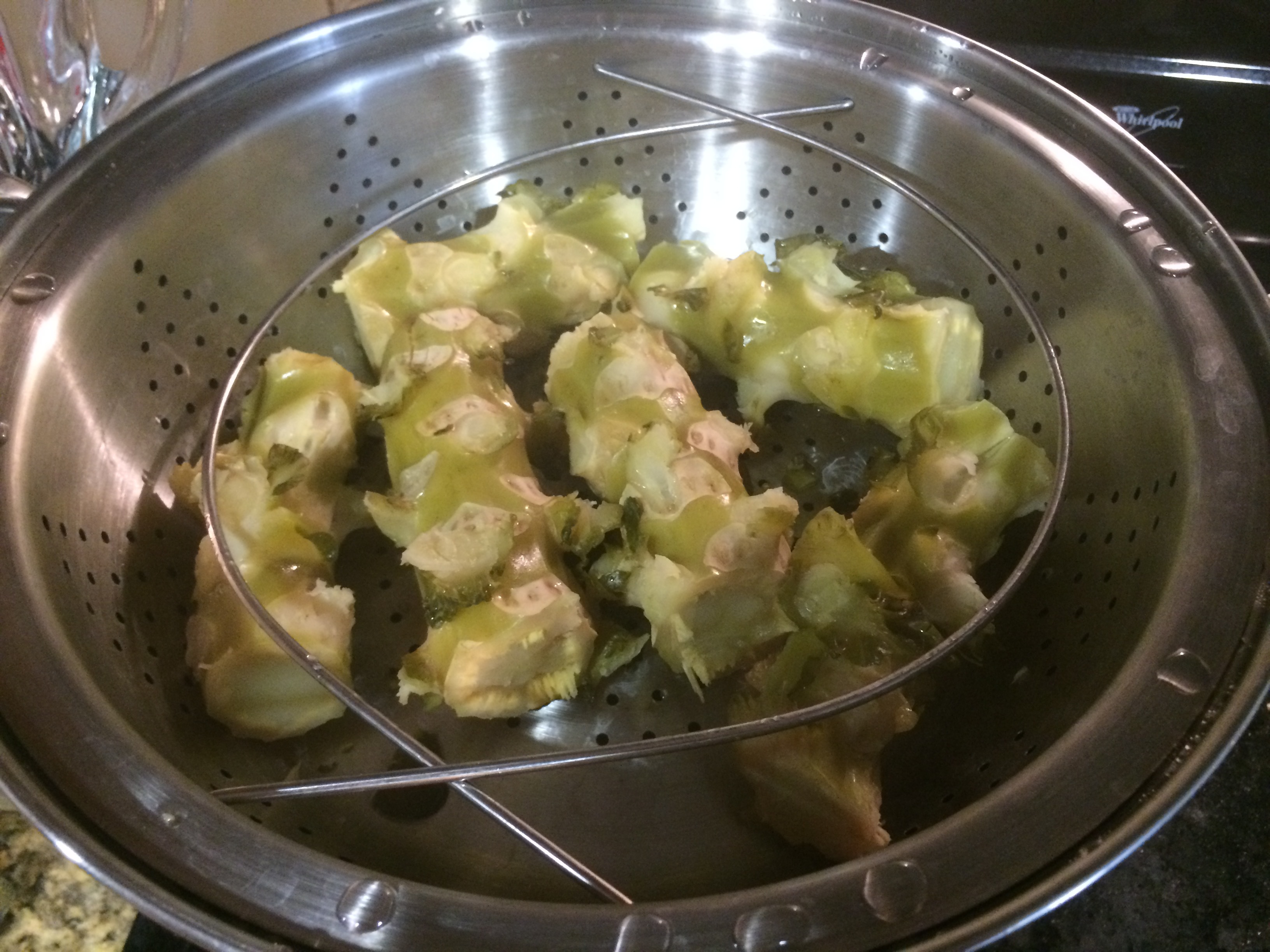
At 1 hour 45 minutes, I could press my thumbnail into the core. I could still have used the outer ring as a bludgeoning weapon, but this qualified as progress.
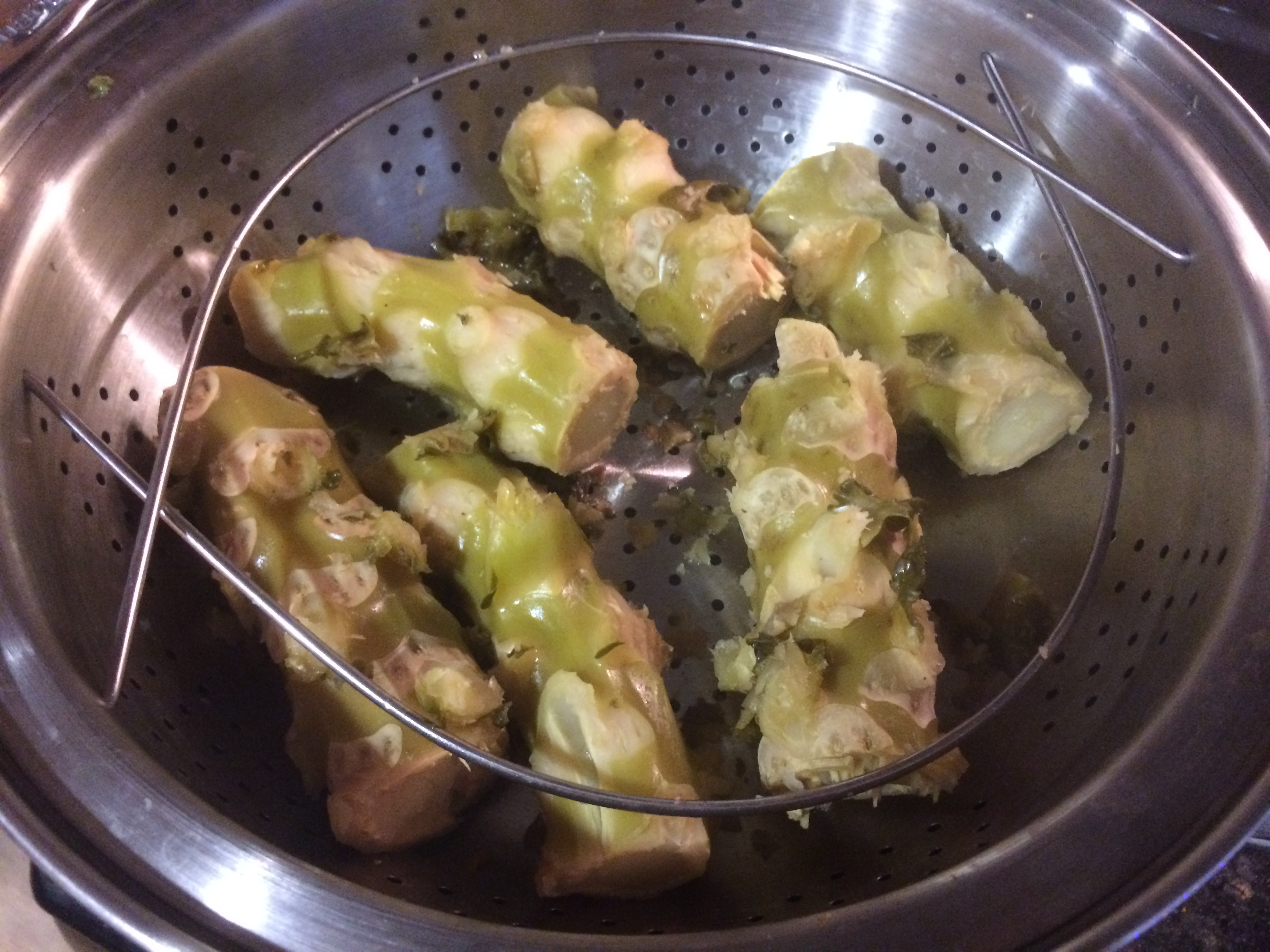
So: the moment of truth. What treasure was inside, assuming I could open them?
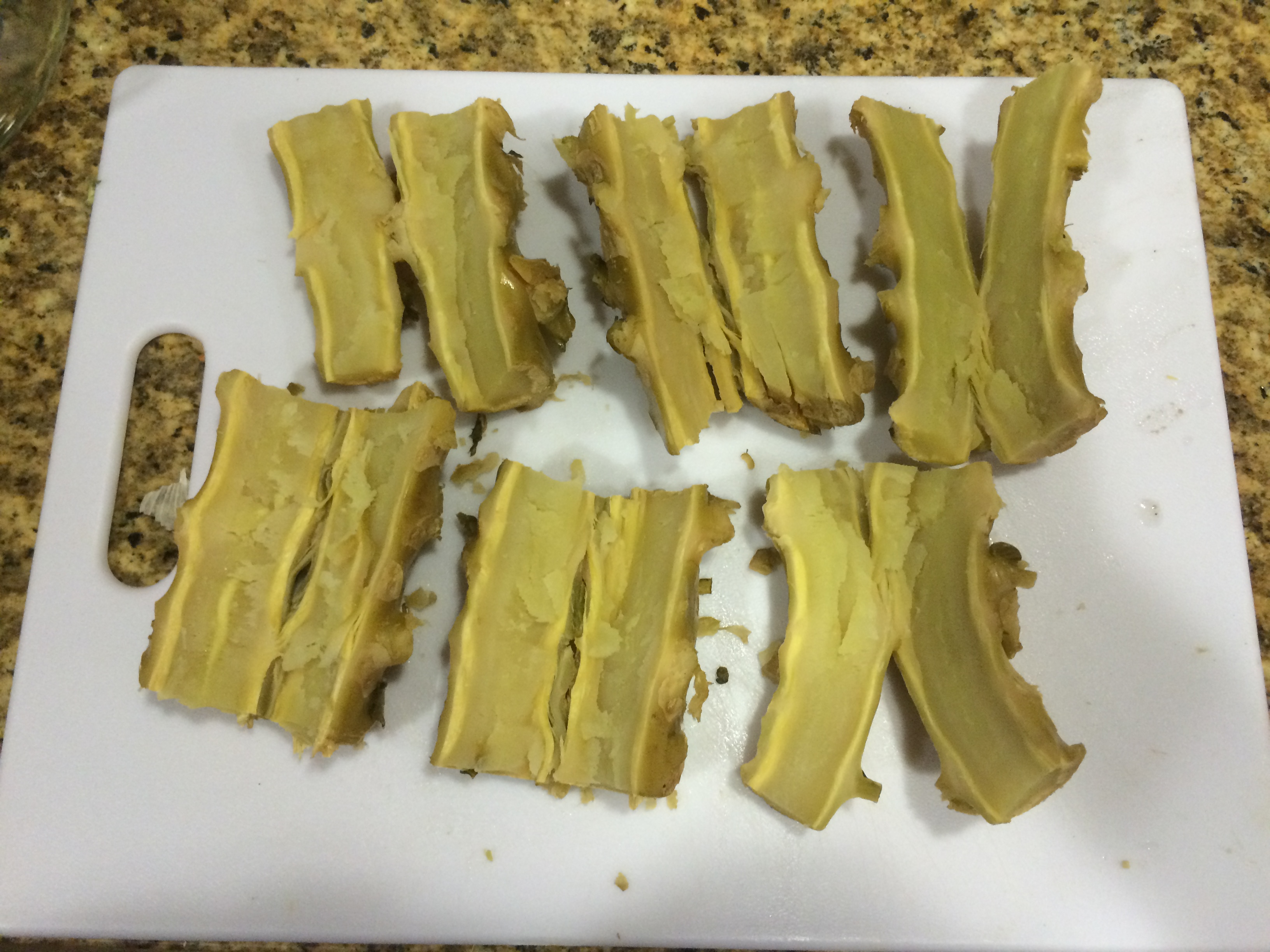
The pith was coarse and could easily have handled another half hour—or even another hour—in the steamer. But it was soft enough to scoop with a spoon.
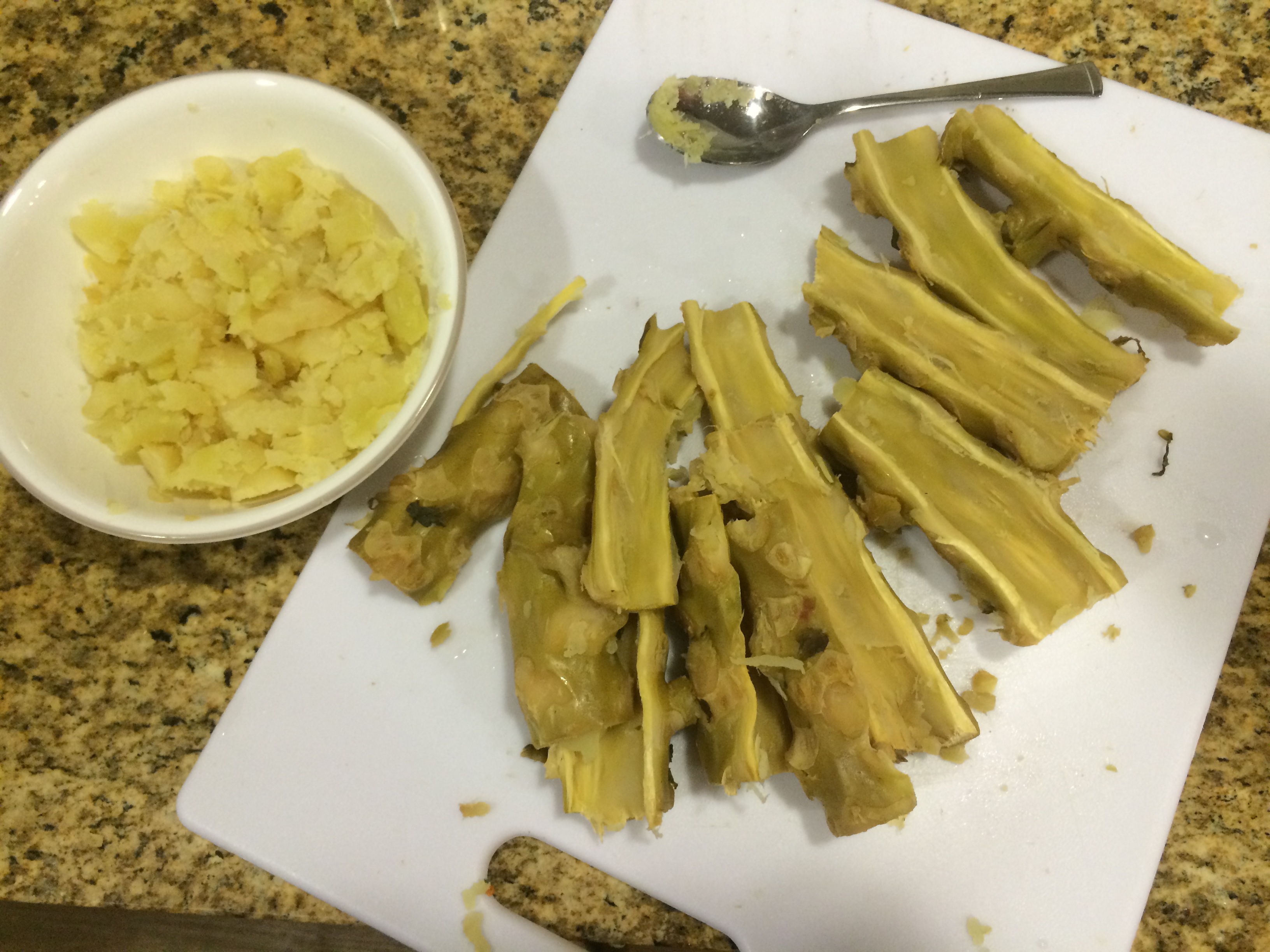
Aaaand now I had a bowl of coarse, warm brassica pulp.
I tasted it. It wasn’t bad at all—somewhere between a broccoli stem and an undercooked artichoke heart. Purée it, maybe, I thought. Add some fat and liquid, spread it on home-baked sourdough, and finish it with parsley so it looks as though it was worth three hours of my life.
Into the mini-prep went the pith, mayonnaise, kosher salt, freshly ground black pepper, rubbed sage, and a little too much fresh lemon juice. I gave it a whirl. Then I added more mayonnaise and gave it another whirl. Then I stopped, scraped down the sides, engaged it in a staring contest to convince it to become a purée, and ran the mini-prep one more time.
And the delicacy pictured above—the featured image—is what emerged. A little too lemony, perhaps. You can’t tell that from the photograph.
Brussels Sprout Stalk Spread
A thrifty, mildly absurd spread made from the tender pith inside a very thoroughly steamed Brussels sprout stalk.
Yield: About 1 cup Prep: Cook:
Ingredients
- 1 fresh Brussels sprout stalk, sprouts and tender top shoots removed
- 2–4 tablespoons mayonnaise, plus more as needed
- 1 teaspoon fresh lemon juice, plus more to taste
- ¼ teaspoon rubbed sage
- Kosher salt, to taste
- Freshly ground black pepper, to taste
- Chopped parsley, for garnish (optional, but persuasive)
- Sourdough toast or crackers, for serving
Instructions
- Cut away the dry base of the stalk. Score the stalk about ¼ inch deep every 6 inches, cutting all the way around, then carefully snap it into segments.
- Arrange the segments in a steamer basket over simmering water. Cover and steam for 1¾–2½ hours, replenishing the water as needed, until the stalks split and the inner pith is soft enough to scoop with a spoon.
- Let the stalk pieces cool until safe to handle. Split or peel away the tough outer shell and scoop the tender pith into a food processor.
- Add 2 tablespoons mayonnaise, the lemon juice, sage, a pinch of salt, and several grinds of black pepper. Process until as smooth as the stalk is willing to become, stopping to scrape down the bowl.
- Add more mayonnaise as needed for a creamy, spreadable texture. Taste and adjust the lemon, salt, pepper, and sage.
- Spoon into a serving bowl, garnish with parsley if desired, and serve with sourdough toast or crackers.
Notes
The exact yield and cooking time depend heavily on the stalk’s size, freshness, and stubbornness. Start conservatively with the lemon; unlike the author, you can always add more.
Congratulations on your success!
I’m also a bit impressed by your overthinking :)
The last two times I bought a whole brussels sprout stalk, I just peeled the stem and ate the core raw. I will admit that “just peeled” is a bit of an understatement. It’s like a particularly recalcitrant woody broccoli stem. I used a combination of knives and brute force fingernail-threating hand-ripping.
The resulting core is like a very dense broccoli stem core. The flavor is strong, with familial resemblance to broccoli, radishes, rutabaga, etc. Cut into small circles (.5 to 1 cm), it works well in a salad.
>Bela<
1. With heavy cleaver of hatchet, cut stalk into 4″- 5″ lengths.
2. With a sharp knife running along the stalk’s axis, the pieces will split open.
3. Place pieces in a bowl with a little water, cover and microwave 5 – 10 minutes.
4. Pith will be very soft and yummy.