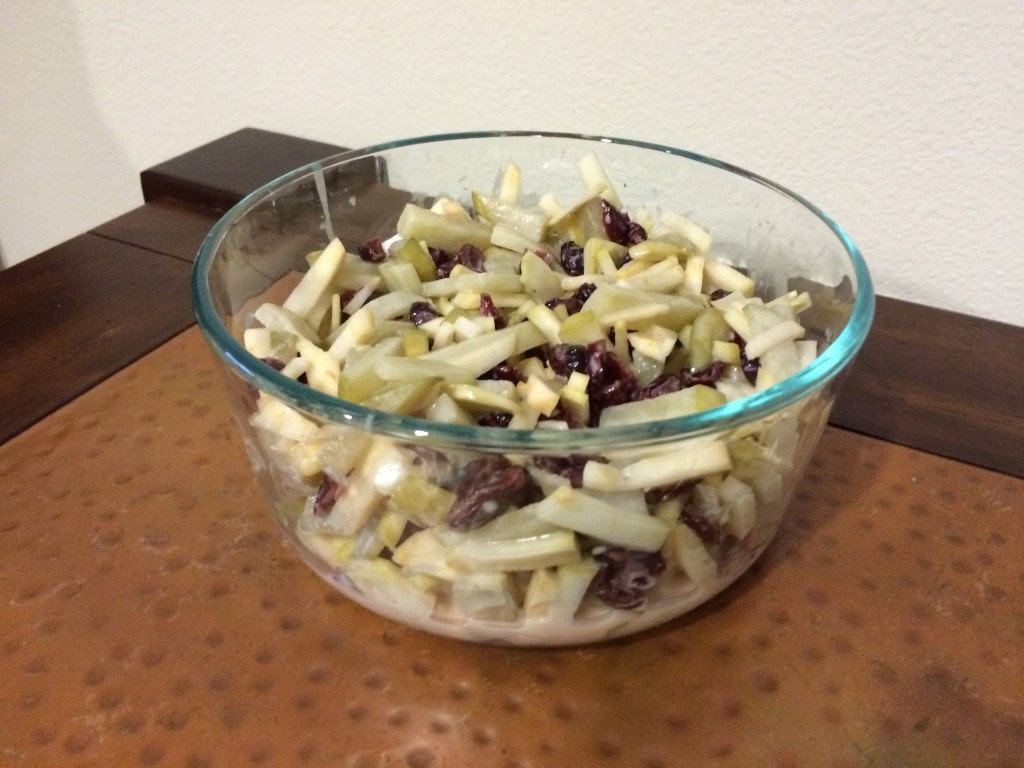
I made this strange-looking salad for Thanksgiving dinner. It looked unusual enough that I posted a photo in my family’s WhatsApp group with the caption, “Any guesses?”
My father replied, “42?”
“That was an unintentionally trick question,” I wrote back. “I have no idea what to call it. ‘42 Salad’ is as good a name as any.”
Each time I shared it with another family member, I asked what I should call it. They would ponder, start proposing names, stop, and eventually decide: “No, ‘42’ is good.”
The recipe begins with fermented celeriac, kohlrabi, and tart green apples, then adds dried cranberries and a sweet, gingery dressing. It’s crisp—almost nutty—plus piquant, sweet, sour, and unexpectedly delicious.
The only catch: you need to know what you’re serving about a week before you serve it.
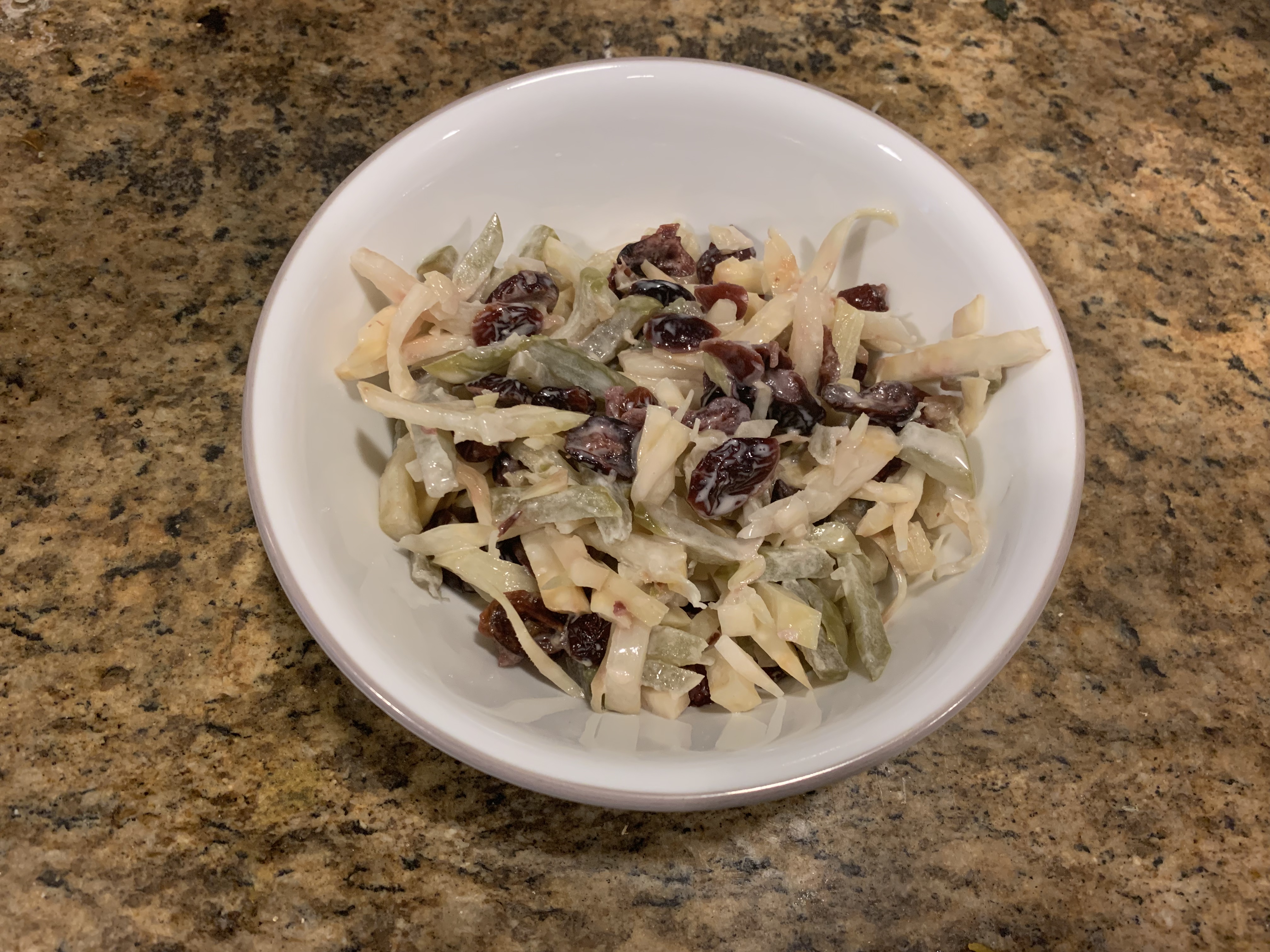
“42 Salad” Fermented Fruit and Vegetable Slaw
A crisp fermented slaw of celeriac, kohlrabi, and Granny Smith apples, finished with dried cranberries and a sweet ginger dressing.
Yield: About 10–12 servings Active time: Fermentation:
For the ferment
- 1 large celeriac
- 2–3 kohlrabi bulbs
- 2 medium-to-large Granny Smith apples
- 1 teaspoon mustard seeds
- 1 teaspoon coarsely cracked black peppercorns
- 1 liter filtered water
- 45 grams canning or pickling salt
For the finished salad
- 2 cups sweetened dried cranberries
- ½ cup mayonnaise
- ¼ cup granulated sugar
- ¼ cup whole milk
- 1 teaspoon finely grated fresh ginger, or to taste
Instructions
- Clean and sanitize a half-gallon glass fermentation vessel, lid or airlock, weight, and utensils.
- Make a 4.5% brine by stirring 45 grams of canning or pickling salt into 1 liter of filtered water until dissolved. Measuring the salt by weight matters because different salts have different crystal sizes.
- Wash the produce under cool running water. Peel the celeriac and kohlrabi, then cut them into matchsticks. Core—but do not peel—the apples and cut them into slightly thicker matchsticks.
- Place the mustard seeds and peppercorns in the fermentation vessel. Firmly pack the celeriac, kohlrabi, and apples on top.
- Pour in enough brine to cover the produce completely. Add a fermentation weight, leaving everything below the brine with adequate headspace above it. Fit the airlock or lid according to its instructions.
- Ferment out of direct sunlight at 68–72°F. Keep the produce submerged and inspect it daily without unnecessary opening. Begin checking at 7 days; the ferment is ready only after active bubbling has subsided and the brine measures pH 4.6 or below. Timing may be longer than 7–8 days.
- When fermentation is complete, drain the fruit and vegetables well and discard the used brine, mustard seeds, and peppercorns. Transfer the fermented produce to a large bowl and toss with the dried cranberries.
- In a separate bowl, whisk the sugar into the milk until mostly dissolved. Whisk in the mayonnaise and ginger.
- Pour the dressing over the salad and toss until evenly coated. Cover and refrigerate for at least 2 hours before serving chilled.
Fermentation safety
This is a custom, refrigerated ferment—not a shelf-stable canning recipe. Keep the produce submerged throughout fermentation and verify a final pH of 4.6 or below with a suitable food pH meter or test strips. Discard the batch without tasting if it develops mold, a putrid odor, sliminess, or other signs of spoilage. Refrigerate promptly once fermentation is complete.
Notes
Use a scale for the salt rather than converting it to tablespoons. Fermentation speed depends on temperature, produce, and microbial activity, so let acidity and activity—not the calendar alone—determine when it is ready.
Try this one. It has tremendous crunch and zing, and it will make people ask questions at any party where you serve it. Whether those questions include “Why is it called 42?” is entirely up to you.
Every bite was absolutely delicious! ❤️
“42” seemed an appropriate name since this salad seems to be the answer to life, the universe and everything.