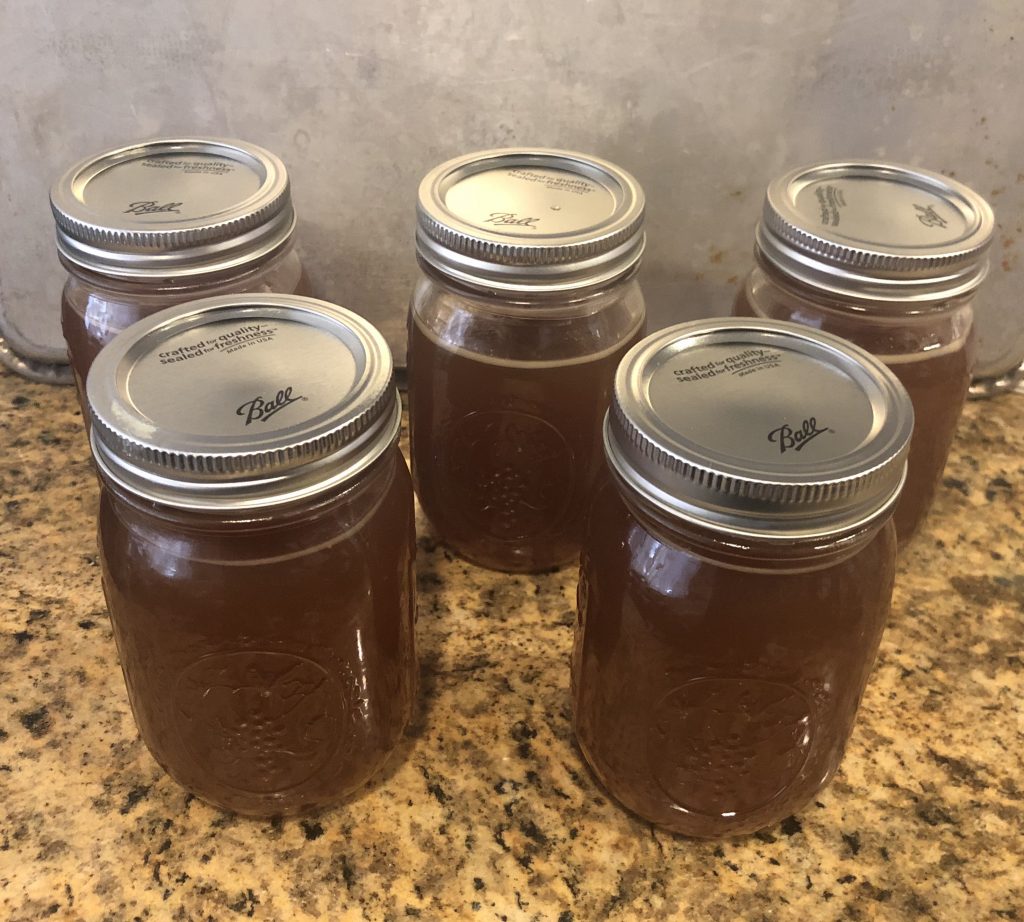
This slow cooker beef bone broth is deeply savory, full-bodied, and naturally gelatinous when chilled. Roasting the bones first builds richer flavor, while a long, gentle cook extracts body from marrow, knuckle, shoulder, and oxtail bones.
Slow Cooker Beef Bone Broth
A rich, savory beef broth made with roasted bones, aromatic vegetables, and a long slow-cooker simmer.
Yield: About 3 quarts Prep: Cook:
Save this recipe on Copy Me That
Ingredients
- 3–3½ pounds assorted beef bones, such as marrow, knuckle, shoulder, or oxtail
- 2 carrots, scrubbed and cut into 2-inch pieces
- 3–4 celery ribs, cut into 2-inch pieces
- 1 leek, white and light-green parts only, halved lengthwise, thoroughly rinsed, and cut into 2-inch pieces
- 1 handful parsley stems
- 5–6 garlic cloves
- 1–2 bay leaves
- 20 whole black peppercorns
- 1 tablespoon apple cider vinegar
- 1 tablespoon Marmite
- Filtered water, as needed (about 1 gallon)
Instructions
- Heat the oven to 425°F. Lightly coat a roasting pan with nonstick spray and arrange the bones in a single layer.
- Roast for 45–60 minutes, turning halfway through, until the bones and any attached meat are deeply browned.
- Transfer the bones to a large slow cooker. Carefully deglaze the roasting pan with boiling water, scraping up the browned bits, and add the liquid to the slow cooker.
- Add the carrots, celery, leek, parsley stems, garlic, bay leaves, peppercorns, vinegar, and Marmite. Add enough water to cover everything by about 1 inch.
- Cover and cook on Low for 24–36 hours, until the broth tastes rich and full-bodied.
- Remove the bones and large vegetable pieces. Strain the broth through a fine-mesh sieve into clean, heat-safe containers.
- Cool promptly in small, shallow containers or in an ice bath, then refrigerate. Once chilled, lift off the solidified tallow and save it for cooking, if desired.
Storage
Refrigerate within 2 hours. Keep refrigerated for 3–4 days, or freeze for 2–3 months for best quality. When freezing in glass, use freezer-safe, straight-sided jars and leave adequate headspace for expansion.
Notes
The cooked vegetables will have given most of their flavor to the broth and can be discarded. Any tender beef picked from the bones can be reserved for another dish.
Step by step


The process of roasting bones prior to a long simmer is essential for developing a complex, deep flavor profile in homemade stocks.
After checking out a number off the articles on ypur site, I truly like your technique of blogging.
I added it tto my bookmark wwebpage list and will bbe checking bback in the nrar future.
Taake a look at myy website aas well and llet mme know your opinion. xnxx
c65mrk
The process of roasting bones prior to a long, slow simmer is an effective way to develop a complex flavor profile for a homemade beef broth.
curj0z
ycqlux
The long, slow cooking process described here is essential for developing a deep, complex flavor profile in bone broth. Roasting the ingredients beforehand is a great technique for enhancing the final result. I work on CloneCut, an AI video tool.
qzxfjk
6nr2gk
hlllpo
f9wxox
5c1jfg
j36uiw
3LYHAZgqUVP0f3vugD4nDqz55C7
wqlk3n
wpj4tr
1
0pvp3t
erfdfg
x4ohbl
iqf6ql
ue2o15
srsgtd
nlwqf6
0buah7
bo79jx
3dp41j
6yi0v7
8rok6y
20gfbk
555gwu
hrz4si
1cetsa
ij28nv
4a8zhp
4nu728
7n63rz
cpge4h
ryqkoa
How do visual creators maintain depth-of-field realism when converting static landscape and architectural photography into moving footage? The techniques outlined in slow cooker beef bone broth recipe – the eclectic quill provide actionable guidance, particularly when combined with dedicated motion generation suites like photo to video generator. Thanks for sharing this well-structured overview!
ksdlo3
aozhmo
gs6ipz