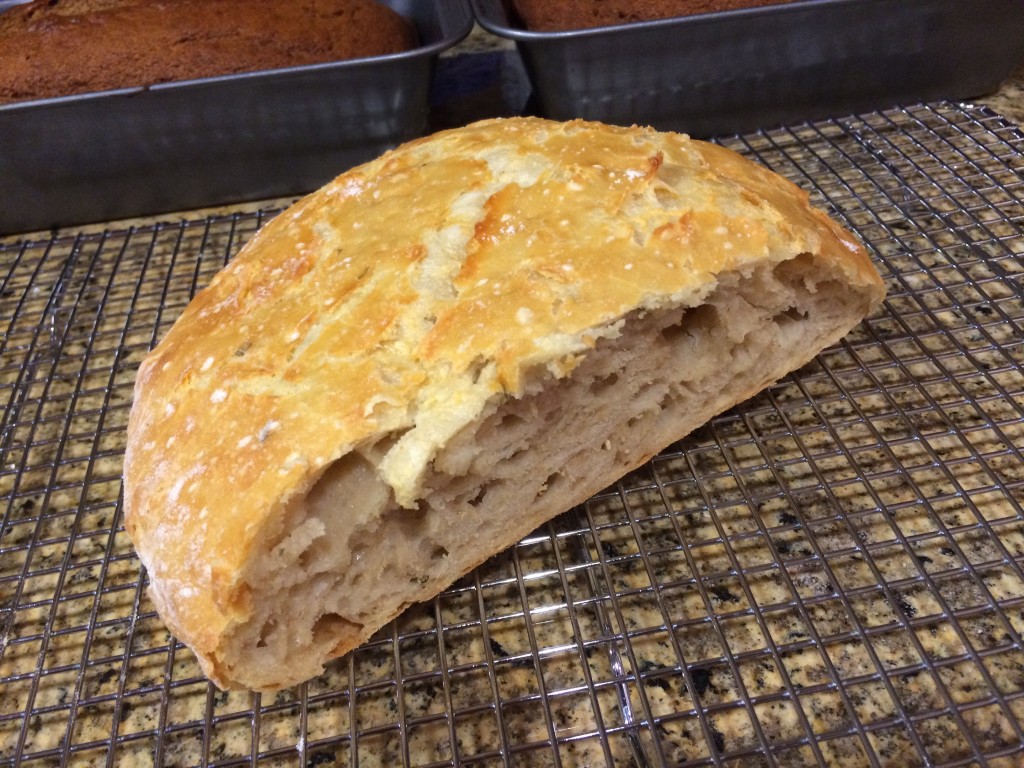
When I shared this bread with my father—another dyed-in-the-wool foodie—he told me it was the best bread he had ever tasted.
“You know, I used to go to Brothers restaurant in Solvang. They had a baker come in every morning and prepare bread for that night’s dinner. I loved that bread. And this is the best I’ve ever had.”
It’s a simple variation on no-knead Dutch oven bread, with fresh rosemary and two assertive Italian cheeses folded into the dough. The ingredients are uncomplicated. The difficult part is waiting 18 hours while the dough quietly turns itself into bread.
The other trick is a cast-iron combo cooker: set the dough on its shallow skillet half and use the deeper half as a dome. You get the steamy environment of a Dutch oven without having to lower soft dough into a deep, blazing-hot pot.
Rosemary Dutch Oven Bread with Parmesan and Romano
A deeply flavored no-knead loaf with a crisp crust, airy interior, fresh rosemary, Parmesan, and Romano.
Yield: 1 round loaf Active time: Rise: Bake:
Ingredients
- 405 grams bread flour, plus more for shaping
- 1 teaspoon active dry yeast
- ½ teaspoon fine salt
- 1½ cups (355 milliliters) warm filtered water
- Leaves from 1½ sprigs fresh rosemary, finely chopped
- ⅓ cup coarsely grated Parmesan and Romano cheeses, loosely packed
Instructions
- In a large bowl, whisk together the flour, yeast, salt, rosemary, Parmesan, and Romano.
- Add the warm water and stir until no dry flour remains. The dough will be wet and sticky.
- Cover the bowl tightly and leave the dough to rise at a moderate room temperature for about 18 hours, until expanded and bubbly.
- Place both halves of a cast-iron combo cooker in the oven, separated so air can circulate around them. Heat the oven to 450°F, then continue preheating the cookware for 30 minutes.
- Meanwhile, turn the dough onto a generously floured work surface. With floured hands, gently stretch the top smooth and tuck the edges underneath to form a round loaf. Avoid pressing out more gas than necessary. Let it rest while the cookware finishes heating.
- Using substantial, dry oven mitts, carefully remove both pieces of hot cast iron and place them on heatproof surfaces. Set the dough on the shallow skillet half, then cover it with the deeper half as a dome.
- Return the covered cooker to the oven and bake for 30 minutes.
- Carefully remove the dome and bake uncovered for about 10 minutes more, until deeply browned. For a more objective check, the center should register about 200–210°F.
- Transfer the loaf to a wire rack and cool for at least 1 hour before slicing.
Safety and equipment
The inverted method is intended for a cast-iron combo cooker whose skillet doubles as its lid. Do not invert cookware that is not designed to function safely in that orientation. At 450°F, both pieces remain dangerously hot for a long time; use dry, high-heat oven mitts, clear the work area, and keep every handle turned away from the edge.
Notes
Bread flour gives the loaf extra chew and structure, but all-purpose flour can still produce good no-knead bread. Because room temperatures vary, judge the long rise by a visibly expanded, bubbly dough rather than the clock alone.
And voilà: you have made “the best bread in the world.” According to my dad—and he does not hand out that title casually.